
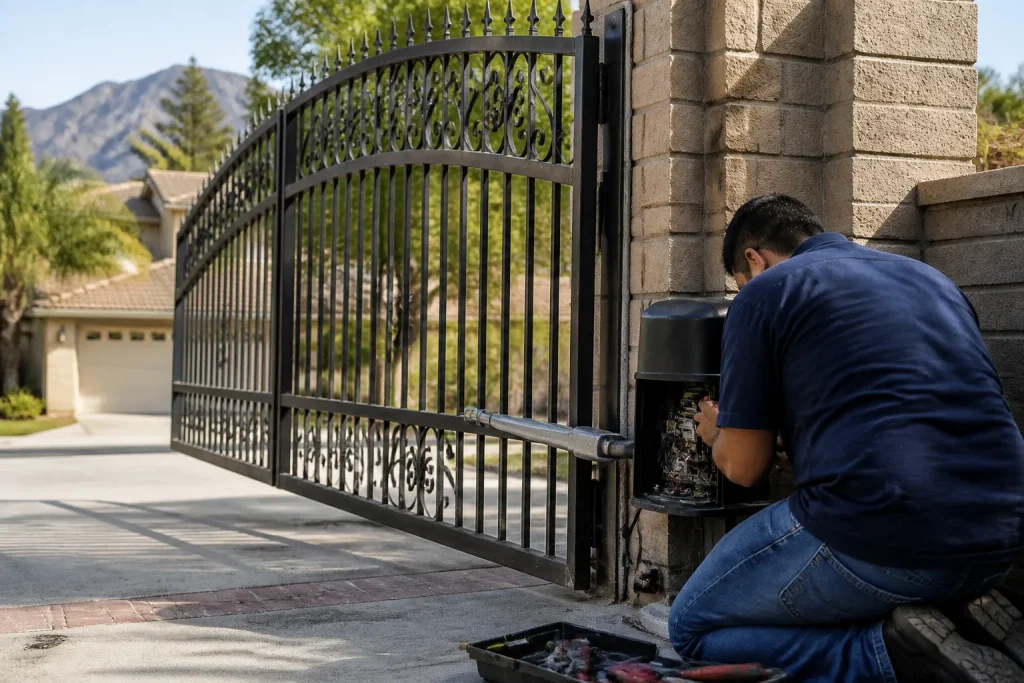
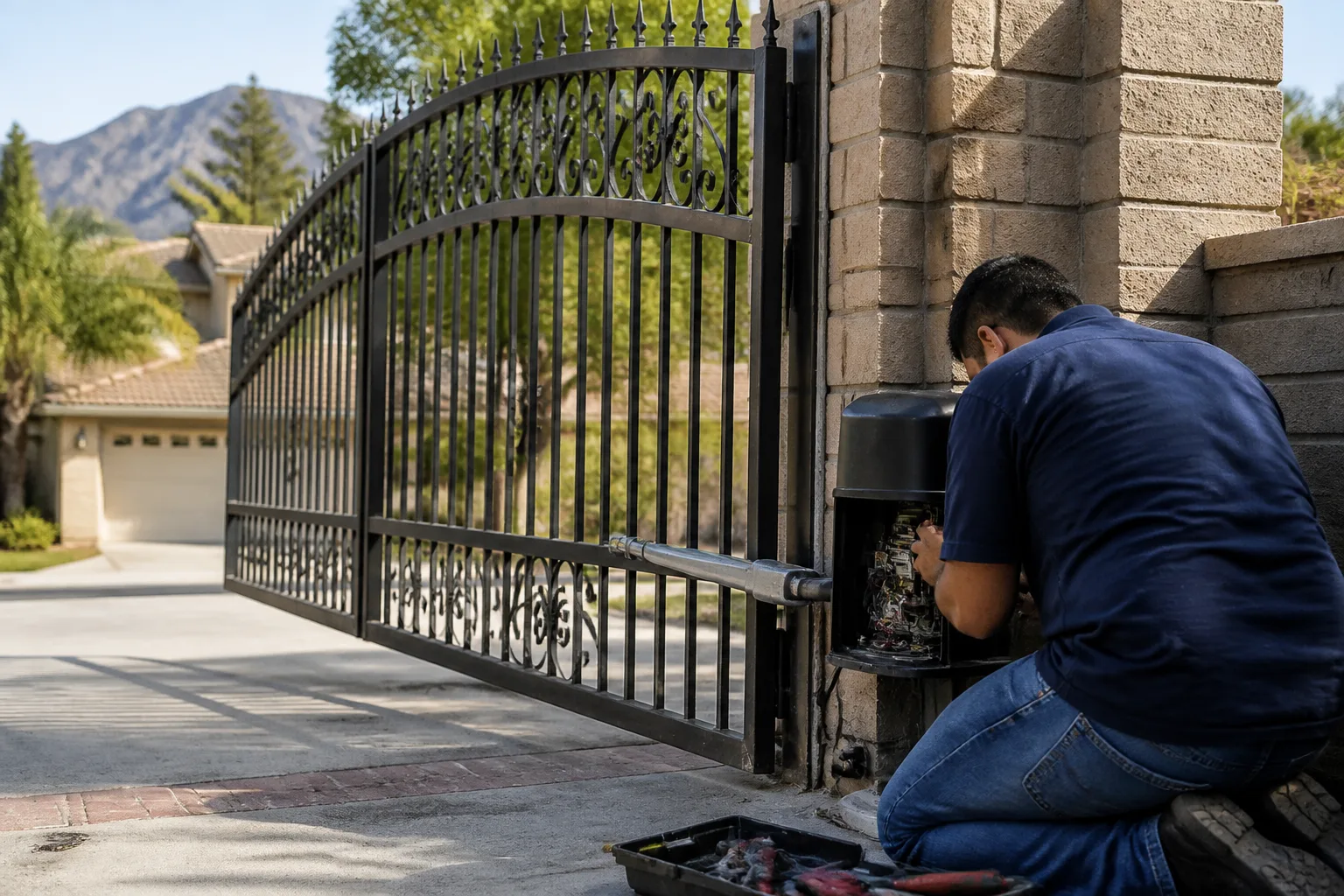
Emergency Gate Repair Near Me: What San Bernardino Homeowners Should Do First
Forcing a stuck automated gate open by hand without disengaging the operator first is the fastest way to turn a small actuator fault into gearbox damage. We’ve seen it happen in San Bernardino more than any other mistake. The part that failed was going to be a modest repair; the part that got destroyed in the same motion is a much bigger one. The twenty minutes after a gate stops working decide whether you’re looking at a straightforward fix or a full drivetrain job. Here’s the right order of operations.
Short version: secure the property, identify the gate type, then disengage correctly before you touch anything. If you’d rather not DIY it, call (866) 389-3501. We answer 24/7.
Key Takeaways
- Never force a gate open before you’ve disengaged the operator. On automated systems, that’s how gearboxes get stripped.
- Swing gates, slide gates, and barrier arms each have their own release procedure. There’s no universal manual release.
- Have your operator brand, failure symptom, and power status ready before you call. It changes how fast the right parts arrive.
- A gate stuck open is a security problem first and a repair problem second. Secure the opening before you troubleshoot.
- Not every failure is an emergency. A gate that’s stuck but secure can usually be scheduled for the next opening, Sunday through Friday.
Why the First Twenty Minutes Matter More Than the Repair Itself
The failure itself doesn’t usually cause the expensive damage. What happens next does. In San Bernardino, where most residential properties sit behind an automated gate and the gate is the primary security boundary, the instinct is to get it open or closed immediately, by whatever means. That instinct is right. The method is where people go wrong.
Three things typically go bad in the first twenty minutes:
- Forcing a gate against an engaged operator. The operator is holding the gate. Pushing through it loads the gearbox and the drive train in a direction they were never designed to take load. A seized actuator becomes a stripped gearbox.
- Cutting power without noting the last state. You lose the diagnostic information that tells a technician whether the fault was in the control board, the operator, or the safety circuit.
- Leaving the gate in the open position unattended. This is the security gap most San Bernardino homeowners create without meaning to. The gate is broken and now the property is wide open.
None of these are hard to avoid. They just need a sequence. That’s what the rest of this piece gives you.
Gate-Type-Specific Emergency Protocol: Swing, Slide, and Barrier Arm
There is no single manual release procedure. Each gate type releases differently, and doing the wrong one can damage the operator or leave you with a gate you can’t move at all. Here’s how each one behaves.
Swing gates
Swing gates are the most common residential setup in San Bernardino. Most swing gate operators have a manual release key or lever on the operator housing. Turn or pull the release, then move the gate by hand. The critical detail: release the operator before you apply any force to the gate. If the gate won’t move freely after release, stop. Something else is binding, and forcing it will make it worse.
Slide gates
Slide gates typically release with a clutch or a manual release lever on the operator, letting the gate roll along its track by hand. On a slide gate, the bigger risk is the track itself. Before you release, look at the track and the rollers. If the gate has jumped the track or a roller has failed, releasing the operator can let a heavy gate drop or shift. Heavy panels can crush. If the gate looks off its track, don’t release it. Call for a technician.
Barrier arms (overhead and parking arms)
Barrier arms fail in a different way. The arm is usually counterbalanced and the operator is often mounted on a pedestal. Most have a manual release mechanism, but the arm can swing down fast once released. Keep clear of the arc of the arm when you release it, and don’t try to hold a falling arm with your body.
Whatever the gate type, the rule is the same: if you’re not sure which mechanism releases it, don’t guess. A wrong release on an automated system can void the operator’s drive train or leave you with a gate that won’t re-engage.
How to Release a LiftMaster, FAAC, or Viking Operator Correctly
Newer isn’t the same as simpler. The three operators we see most often on San Bernardino properties are LiftMaster, FAAC, and Viking, and each one releases differently. Knowing which you have before you go out saves time and damage.
- LiftMaster. Most LiftMaster gate operators use a manual release lever or key on the operator housing. You disengage, move the gate by hand, and re-engage when power returns. Re-engaging incorrectly is the common failure point: if the gate doesn’t lock back in solidly, the operator will run against a load it can’t move. If it doesn’t re-engage cleanly, stop and call.
- FAAC. FAAC operators typically use a release key or lever on the motor housing. The housing placement matters: on some FAAC installs the release is tucked where it’s hard to reach without getting into the swing path of the gate. Secure the area before you release it. FAAC boards are also sensitive to power interruptions; if the gate died after a power blip, don’t assume the operator is the problem.
- Viking. Viking operators generally use a manual release lever, but the release feel is different from a LiftMaster: you’ll know it’s disengaged because the gate moves freely with light hand pressure. If it’s still stiff after release, the issue is likely mechanical, not the operator.
One thing that applies across the board: don’t cycle power repeatedly hoping the gate resets. On LiftMaster and FAAC boards especially, repeated power cycles while the gate is in a fault state can leave the board in a locked condition that needs a proper reset, which is a technician job, not a homeowner job. And never open the operator housing to reach the release if the housing is sealed or the release isn’t visible from outside. That’s the point where a technician should be the one touching it.
Gate Stuck Open: Interim Security Options Before the Technician Arrives
A gate stuck open in San Bernardino is a security gap. Treat it as one. Before you spend time on the repair, close the gap. Your options, roughly in order of speed:
- Physical barrier. A vehicle parked across the opening, a temporary panel, or anything that physically blocks the drive is the fastest fix. It buys you time and it’s free.
- Temporary lock point. If the gate is in the closed position and stuck, a padlock or chain through the gate frame and a fixed post keeps it shut. Don’t lock a gate that’s already stuck open; you’ll just be fighting the operator later.
- Property security. If the gate guards more than a residence, for example an HOA common area or a commercial lot, contact whoever manages site security. A broken gate at a commercial property is a liability question, not just a repair question.
- Wait for the technician. If the gate is closed and secure, and nothing is blocking access, waiting is often the right call. A gate that’s stuck shut but otherwise sound isn’t a security emergency. It’s an access problem, and that can usually be booked for the next opening.
The distinction that matters: a gate stuck open is a security problem. A gate stuck closed is an access problem. Handle them in that order and you’ll avoid the panic moves that cause the secondary damage.
What to Have Ready Before You Call for Emergency Gate Repair in San Bernardino
This is the part most homeowners skip, and it’s the part that makes the biggest difference to how fast the repair happens. When you call, we need four things:
- The operator brand and model. LiftMaster, FAAC, BFT, Linear, Viking, and the rest each have their own common failure points. Knowing the brand before the technician arrives means the right parts come with them instead of a second trip.
- The failure symptom. Did the gate stop mid-travel? Did it stop responding to the remote? Is the operator making a sound but not moving the gate? Each one points to a different part of the system: operator, control board, or safety circuit.
- Power status. Is the operator getting power? Is the control board lit? Was there a recent power interruption in the neighborhood? This alone can save a diagnostic step.
- Last-known working state. When did it last work correctly, and what was happening right before it failed? A gate that failed after a storm is a different call than one that failed mid-cycle with no warning.
With those four pieces, a technician can walk in knowing what they’re likely facing. That’s the difference between a same-day fix and a follow-up visit. Our technicians have up to 13 years of experience, and we service nine major gate brands including LiftMaster, FAAC, BFT, and Linear, so there’s no “we don’t work on that model” dead end.
If you’re not sure what you have, a photo of the operator label and a description of what the gate is doing is enough to start.
True Emergency vs. Urgent Repair: What Actually Waits Until Morning
Not every gate failure needs immediate attention, and knowing the difference saves you a panicked call and a rushed decision.
A true emergency is a security breach or a complete failure of access. That means a gate stuck open on a property that depends on it for security, a gate stuck closed with someone who can’t get out, or a gate off its track with a panel that could fall. Those get handled first.
An urgent repair is a gate that’s stuck but secure, an operator that’s noisy but working, or a remote that’s intermittent. Those can be scheduled for the next opening, Sunday through Friday, 7am to 7pm. There’s no reason to force a repair on a gate that’s doing its job, even if it’s doing it badly.
On cost: pricing is set per job by a written estimate, and we quote and agree the price before any work starts. We don’t add emergency surcharges or after-hours premiums. A gate repaired at 7am and a gate repaired at 3pm on the same day cost the same. What changes the price is the damage, not the clock. The best way to keep the estimate low is to avoid the secondary damage described above.
When to Call a Pro
Call a professional if any of these are true:
- The gate won’t move freely after you’ve released the operator.
- The gate is off its track, or a slide gate panel looks unstable.
- The operator housing is sealed and you can’t reach the release safely.
- The gate is stuck open and you can’t secure the opening.
- The board is in a fault state after a power interruption and won’t reset.
Electrical work at the operator, control board, or safety edge is not a homeowner job. It’s a trained-professional job, both for safety and because the wrong repair voids the operator.
Related reading: if your gate problem is in the operator, control board, or access hardware, that’s electric gate repair. For mechanical failures in the gate itself, see gate repair. If you’re figuring out who to call, start with Valor Gate Repair.
The Bottom Line
Secure the opening first. Identify the gate type. Release the operator correctly or don’t touch it. Then call with the brand, symptom, power status, and last-known state ready. Do those four things in order and you’ll avoid the secondary damage that turns a small repair into a large one.
We’re a dedicated gate specialist in San Bernardino, servicing LiftMaster, FAAC, BFT, Linear, and five more brands, with three service lines: gate repair, electric gate repair, and gate installation. If you’re in San Bernardino and need help, Valor Gate Repair offers free estimates. Call (866) 389-3501. We answer 24/7. Fast dispatch from 7am to 7pm, Sunday through Friday.
Frequently Asked Questions
No, not before you disengage the operator. Forcing a gate against an engaged operator loads the gearbox and drive train in a direction they weren’t built to take, which is how a small actuator repair becomes a full gearbox replacement. Release the operator first, then move the gate by hand. If it won’t move freely after release, stop and call.
A gate stuck open on a property that depends on it for security is an emergency. A gate stuck closed and secure is urgent, and it can usually be scheduled for the next opening, Sunday through Friday. Call (866) 389-3501 for guidance, and we’ll help you figure out which one you’re facing. We answer 24/7.
No. Pricing is set per job by a written estimate, and we quote and agree the price before any work starts. There’s no emergency surcharge or after-hours premium. What changes the price is the damage, not the time of day. Call (866) 389-3501 for a free estimate.
The operator brand and model, the failure symptom, whether the operator has power, and when it last worked correctly. Have those four ready and a technician can arrive with the right parts the first time. For an exact quote on your situation, call (866) 389-3501. Estimates are free.
Written by the team at Valor Gate Repair.
Need Gate Repair Help?
Call Valor Gate Repair - licensed & insured, here with fast help in San Bernardino.
(866) 389-3501